
CEM-Hubs turns maritime energy transition ambition into action at COP31
Antalya, Türkiye, 11 November 2026 – The Clean Energy Marine Hubs initiative (CEM-Hubs) will reinforce its commitment to accelerating implementation across the global energy-maritime value chain at COP31. CEM-Hubs brings governments and industry together to advance the infrastructure, investment and practical solutions needed for the transport and use of low-carbon fuels at scale.
COP31 will place a strong emphasis on implementation and electrification, with the COP31 Presidency setting an ambition to increase the share of final energy demand met by electricity to 35% by 2035. CEM-Hubs will contribute to this goal through multiple events including the Delivering the Belém 4x Pledge, the Clean Energy Ministerial (CEM) Future Fuels session and a dedicated maritime electrification session.
From frameworks to implementation
CEM-Hubs’ COP31 engagements build on progress over the past year, including the EY-CEM-Hubs Ministerial Call for Action and the Port Readiness Level Tool for Clean Cargo Fuels. An IRENA-IMO Global Study on energy and maritime infrastructure is also underway. Together with the CEM-Hubs Blueprint, these initiatives identify the investment conditions, infrastructure and collaboration needed to develop a global clean-energy maritime transport network.
Head of Energy Transition and CEM Hubs lead for the International Chamber of Shipping Nelson Mojarro said:
“COP31 reinforces a simple message: the technologies, expertise and ambition required for the energy transition are developing rapidly, but progress depends on bringing the different parts of the value chain together. CEM-Hubs is focused on moving from frameworks to implementation, connecting governments and industry so that promising solutions can be tested, scaled and ultimately deployed.”
Industry action provides practical proof points
CEM-Hubs connects policy ambition with practical industry experience, helping translate emerging solutions into real-world applications.
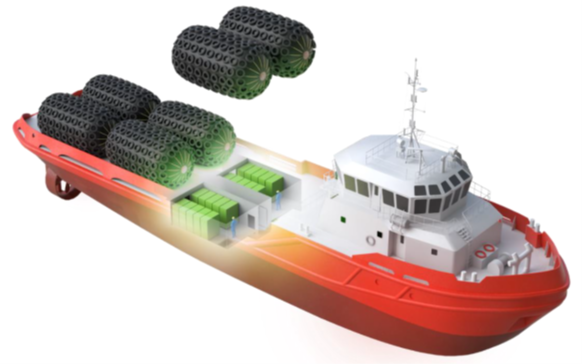
One example is the collaboration between AET, a shipowner, and Fleetzero, a battery technology company, to retrofit the AET Innovator, a lightering support vessel, with plug-in hybrid-electric propulsion. When it enters commercial service in the U.S. in December, the AET Innovator will become the world’s longest-range plug-in battery-hybrid vessel. Safety is integral to the design, incorporating lithium iron phosphate (LFP) battery technology, one of the most thermally stable lithium-ion chemistries.
The project demonstrates how battery-electric technology can be applied in real-world maritime operations and provide operational learning that can inform potential wider applications.
The project incorporates Fleetzero’s modular marine battery technology. AET has estimated that the hybrid-electric configuration could reduce greenhouse gas emissions by approximately 82% on a tank-to-wake basis compared with a conventional lightering support vessel, equivalent to an estimated 1,220 tonnes of greenhouse gases avoided annually.
CEM-Hubs’ broader work similarly recognises that the energy transition will require multiple pathways, with electrification complementing the development and movement of low- and zero-carbon fuels.
Nick Potter, Co-chair of the CEM-Hubs Steering Committee and Chair of the CEM-Hubs Private Sector Group, said:
“The value of CEM-Hubs is in connecting policy ambition with what industry is actually learning on the ground. Projects such as AET’s work with Fleetzero give us practical insight into where electrification can make a difference, while the work across fuels, ports and infrastructure helps tackle the wider challenge. Bringing these experiences together is how we move from ambition to implementation.”
Building the next phase
CEM-Hubs will now focus on translating its Blueprint and supporting tools into an implementation agenda with governments, industry and implementation partners. The aim is to unlock scalable investment across the energy-maritime value chain, enabling shipping both to adopt cleaner energy and support its movement globally.